
Brace Yourself: Emotion as “Expected Motion”
Emotion Isn’t Just a Feeling. It’s a Movement That Never Happened.

“If all time is eternally present
All time is unredeemable.
- T.S. Eliot, Burnt Norton, Four Quartets, 1936
In 1944, Hiroo Onoda, a Japanese soldier, was posted to a small island in the Philippines with a simple directive: conduct guerrilla warfare and never surrender. The war ended a year later—but no one told Onoda in a way he could accept. For the next 29 years, he remained hidden in the jungle, armed, alert, and ready for a battle that no longer existed. It wasn’t until 1974, when his former commander arrived to formally relieve him of duty, that Onoda finally laid down his weapon.

In a way, many of us are like Onoda. Our bodies can stay in a state of emotional readiness—braced to act, defend or run—long after the moment that called for it has passed. And often, we don’t even know it. We just feel… stuck. Tense. Wired. Waiting.
But if we can find the right connection, and the right release process, we too can stand down and let go of some of the accumulated emotional baggage we carry.
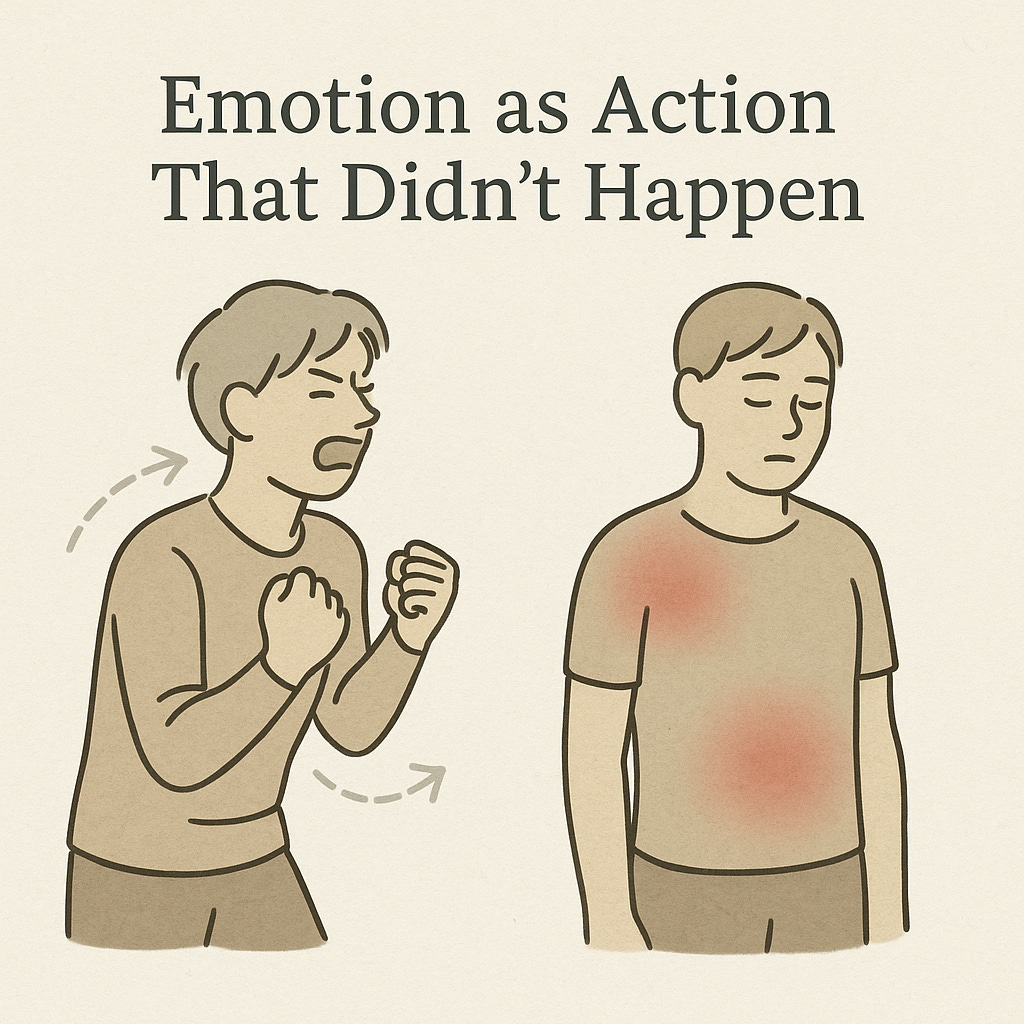
Restored Emotion as Action That Didn’t Happen
Emotion isn’t just what you think or feel. It’s also what your body was ready to do—but didn’t. And still holds onto.
Think about the times you wanted to cry but didn’t. Or wanted to yell but swallowed it. Or felt a jolt of energy to push back, but instead you shrank inward. That “readiness without release” doesn’t necessarily disappear. It lingers in your muscles, your posture, your breath.
We call this latent proprioception—a quiet, persistent awareness of movements that were prepared but never carried out.
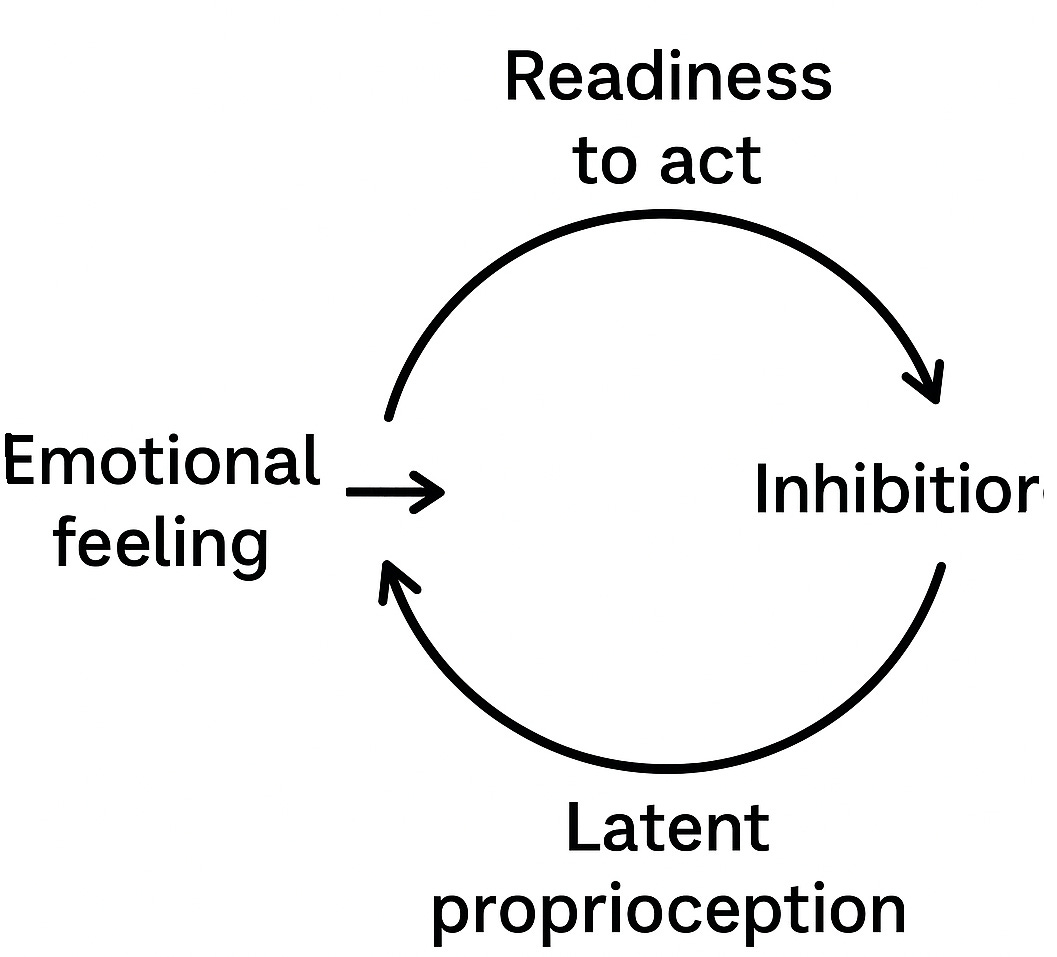
Underneath, this involves inhibited efference1: motor commands that were readied but either suppressed in the brain (central inhibition) or blocked along the spinal pathways (spinal inhibition2). Even without movement, the body holds that subtle state of “just about to.”
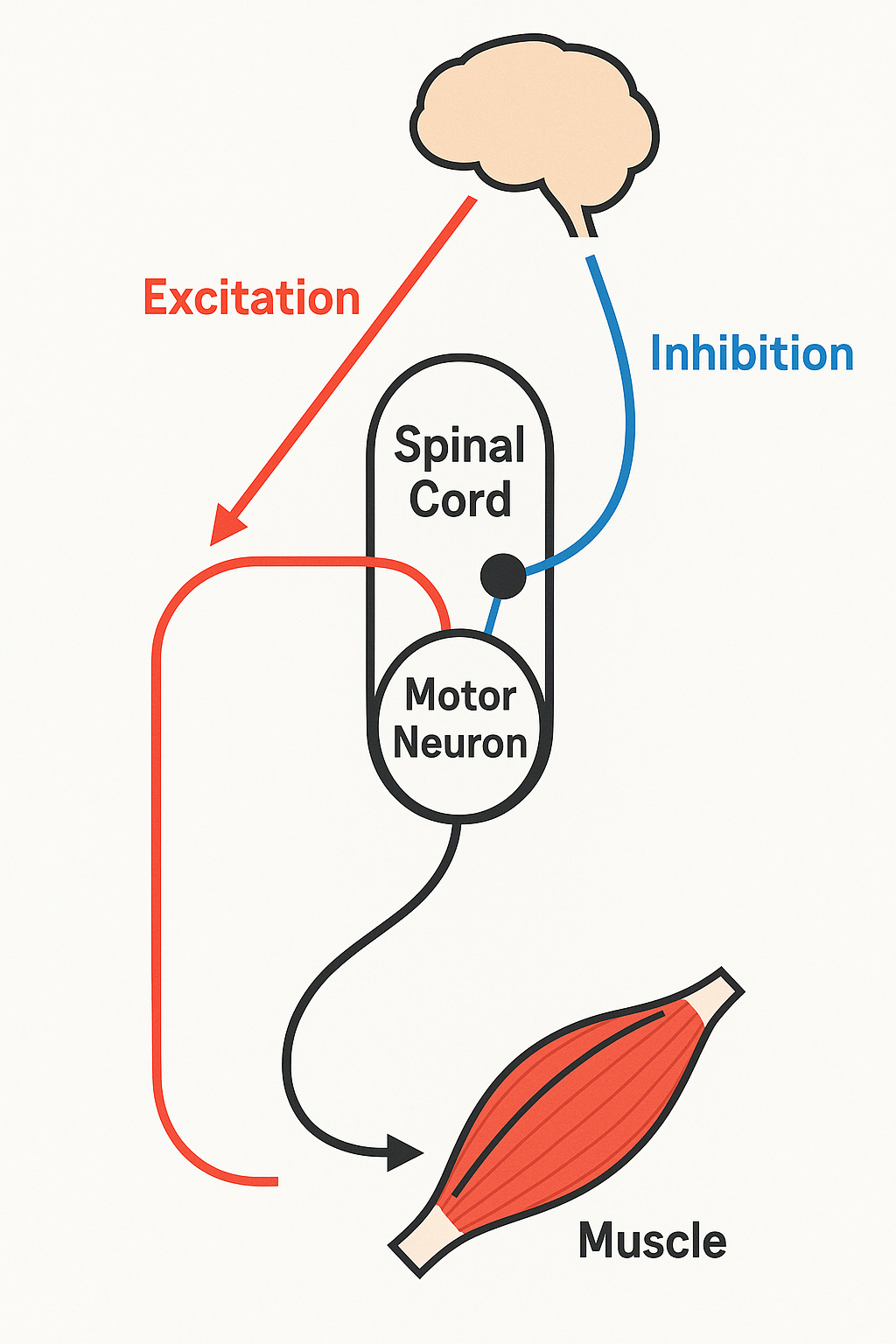
Like a sneeze that never comes, a sentence that dies on the tongue, or a punch halted mid-swing. That energy doesn’t always vanish—it can stay in the body as residual tension, later surfacing as heaviness, tightness, or an unfinished sense inside.
We see this not only in modern therapy rooms, but also woven through literature itself:
Latent Proprioception in Literature
“Miss Havisham was once a woman ready to wed — her body adorned for a future that never came. When jilted, she did not simply abandon her bridal preparations; she preserved them, embalmed them. The dress yellowed, the cake rotted, and her very posture seemed arrested at the altar, forever braced for vows that would not be spoken.”
So goes the tragedy in Great Expectations.
In Miss Havisham, Dickens gave us a vivid portrait of latent proprioception — a body held in readiness for an act that never completed. But more than that: by refusing to process her grief, she turned her stuckness outward, grooming young Estella to break hearts as hers was broken.

Literature is strewn with such figures: Hamlet, endlessly ready to avenge but paralyzed by hesitation; Pip himself, forever straining toward a gentleman’s life that slips from reach; even poor Lady Macbeth, scrubbing imagined stains from hands forever half-locked in the gesture of guilt.
We might see these characters not just as metaphors for thwarted longing, but as illustrations of the very mechanism by which unresolved action becomes the quiet root of emotional suffering — and sometimes cruelty.
Interoception as a Complex Multi-Sensory Domain
We often think of interoception as a single sense, our general awareness of what’s happening inside. But that’s like treating exteroception—sight, hearing, taste, smell, touch—as if it were one thing.
In reality, interoception is many senses, each streaming its own information to shape how we feel physically and emotionally:
Visceroreception: perceptions of internal organs—racing heart, churned stomach.
Nociception3: detection of internal pain or threat, giving urgency to emotion.
Endocriception4: sensing shifts in hormonal climate that set mood tone.
Latent proprioception: felt readiness for movements that never happened.
Thermoception: sensing internal heat or chill, adding temperature to emotion.
Osmoreception: monitoring hydration and blood concentration, shaping thirst or sluggishness.
Baroreception: sensing blood pressure shifts that tie to stability or faintness.
Vestibular sense: inner ear signals of balance, feeding calm or disorientation.
When we feel emotion, it’s not from a single internal message, but an intricate chorus of these different voices, woven by the brain into the tapestry of experience.
So next time you feel tense with anticipation or heavy with sadness, it’s worth wondering: is that your gut’s churn, your hormones whispering, your shoulders bracing, your inner thermostat shifting?
How Internal Senses Relate to the Classic Five External Senses
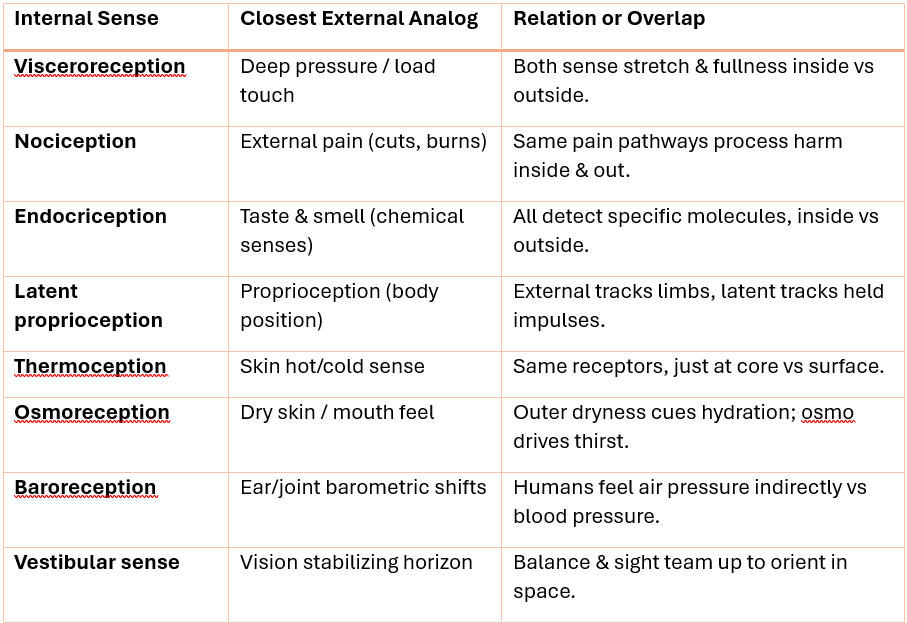
Together, they create a continuum from inside to out—reading what’s happening within and what’s pressing from without.
Individual Variations in Sensitivity
Just as some people have sharper hearing or keener taste, we also vary in how vividly we sense what’s happening inside. Some feel every heartbeat or flutter of cortisol; others barely notice. This can be a gift—adding intuition, bodily awareness—or a liability, amplifying anxiety, pain, or overwhelm.
What sharpens perception can also sharpen vulnerability.
Predictive Action Processing: Emotion as Expected Motion
The brain doesn’t just wait for data. It predicts. In perception, it anticipates sights and sounds based on past experience, only updating when surprised.
The same happens in action. The brain builds anticipatory motor patterns, readying the body to move before evidence demands it. This saves energy, reduces surprise, and speeds reaction.
But in trauma, phobia, or chronic anxiety, these systems get rigid. The body keeps preparing for danger, even when none is present—avoiding corrective experiences, holding itself in check. The result? Latent proprioception: unresolved readiness that quietly shapes how we feel.
In this light, the “e” in emotion could stand for “expected.” Emotion is expected motion—a forecast of how we’re poised to move. When movement is continually braced but never completed, it leaves tension that thought alone can’t untangle.
Emotion = Expected Motion
The body doesn’t just feel. It forecasts. Emotion is how we sense the shape of action before it happens—or doesn’t.
Defragging the Body & Why Talk Isn’t Always Enough
Just like a hard drive, the body builds up fragmented files—stalled impulses that clutter the system. Somatic therapies, yoga, and breathwork help “defrag,” letting old motor commands reorganize and finally settle. Not by replaying trauma, but by completing the loop gently, symbolically.5
Talk therapy like CBT is vital, but people often say: “I get it intellectually—but I still feel it.” Because what’s stuck isn’t only in the story. It’s also in the motor system. Sometimes, healing means movement—a stretch, a breath, a push—unlocking the old lock with a subtle click.
How to Begin Completing the Loop
Notice the gesture: What part of your body is bracing? Where would it move if it could? Follow it a little.
Reclaim the breath: Place a hand on your chest or belly. Complete one full breath cycle.
Use props: Push a wall, grip a pillow. Not drama—just safe motor completion.
Micro-movements: A shrug, a yawn, a subtle shift.
Dance or free movement: Let your body unwind without performance.
Let yourself cry (or laugh): Both are natural tremors that release tension.
Gently build body awareness: Mindfulness, yoga, somatic practices.
If trauma is deep, go with a guide: A skilled witness makes it safer.
Not therapy—but a start to telling your body it’s safe to stand down.
Beyond Release: Prevention & Channeling
Inhibition is not the enemy. It’s how we live together—holding back impulses protects others. But chronic suppression strains the system. The art is balance: knowing when to hold back, when to express.
Sometimes we channel energy creatively—through art, humor, sport, advocacy. Other times, prevention works upstream: CBT (rooted in Stoicism) shows many urgent demands are neither urgent nor important. Buddhist traditions teach that seeking happiness outside ourselves often backfires, leaving unmet impulses. Fewer rigid expectations means fewer inhibited actions.
Release is good. Prevention is better. A life with fewer stuck impulses is a life more aligned.
Two Minds, One Feeling Body
In his wonderful book The Master and His Emissary, Iain McGilchrist describes two broad ways our minds work: one is focused, grasping, and analytic. The other is broad and holistic, holding past, present, and future all at once — like seeing time as a single block.
It’s almost like we have two minds living side by side, or two conjoint selves.
Emotion may be where these two minds meet. It’s the ripple or tension created when the world we remember and expect presses into the narrow space of what’s happening right now. That’s why a sudden feeling might carry traces of old memories, future hopes, and the urge to act — all at once.
At night, our brains store the day’s moments into that bigger timeless library. During the day, the contents of that library color what we see and feel.

It’s a thought for another time — but it might explain why emotions so often link who we were, who we hope to be, and what we’re doing right now.
Measuring Latent Proprioception
So how might we actually measure latent proprioception — this idea that the body holds a readiness to act that never completed?
It’s early days, but clues are emerging. Subtle electrical signals in the muscles (via EMG) can reveal low-level tension or micro-activations that never turn into full movement. Our posture and tiny repeated shifts — picked up by motion sensors or careful observation — can also betray old impulses still “waiting.”
Our heartbeat, breathing, and skin conductance can show the body gearing up for action that never arrives. Heart rate variability (HRV) is particularly intriguing here: because it reflects the balance between sympathetic tension and parasympathetic calm, a chronically low HRV during waking life — especially when contrasted with the higher, more settled HRV typical of deep sleep — might hint at a nervous system still subtly bracing.
Meanwhile, brain scans and EEG studies already show motor circuits lighting up during imagined or inhibited acts, suggesting the nervous system prepares for motion even when we stay still.
There’s no single blood test for latent proprioception. But by combining these methods — muscle activity, subtle movements, autonomic signs like HRV, and patterns of motor readiness in the brain — we may begin to capture the ghost traces of actions that shaped our feelings long after they were stifled.
Conclusion: Where This Leads Next
This article builds on my previous exploration of endocriception—how we sense our internal hormonal climate—and together they open a richer map of how emotion is constructed in the body. In future articles, we’ll keep unpacking this broad terrain of emotion. There’s much more here, and we’re only beginning.
Postscript: Building on Barrett
Lisa Feldman Barrett’s theory of constructed emotion powerfully shows how we interpret bodily signals through experience and culture. This work doesn’t oppose her—it deepens the foundation.
Instead of seeing interoception as a single stream, it frames it as a multi-sensory orchestra—visceroreception, nociception, osmoreception, baroreception, endocriception, latent proprioception, and more. Each adds its own timbre.
Where Barrett highlights how we make meaning of body signals, this view focuses on what the body was prepared to do. Emotion isn’t just a reading of internal state—it’s a residue of expected motion that never fully arrived.
Access More Detailed Paper
In addition to this article I have posted a more detailed scientific paper on ResearchGate. You can access it here Emotion as Expected Motion: A Multi-Sensory Interoceptive Model Centered on Latent Proprioception
Efference means outgoing motor signals, vs afference (incoming sensory). So inhibited efference means impulses readied but not executed.
Central inhibition happens in the brain, spinal inhibition in local cord circuits blocking motor signals.
Nociception detects harmful stimuli, often integrated in regions like the insula and anterior cingulate tied to emotional salience.
Endocriception describes the proposed sensing of hormonal shifts via brain regions (like circumventricular organs, hypothalamus) and bodywide receptors.
Emerging work on psychedelic-assisted therapy suggests compounds like psilocybin or MDMA may help “loosen” rigid predictive models—essentially aiding neurophysiological defragging by relaxing high-level expectations, letting stuck patterns reorganize. Still experimental, but a compelling metaphor for how they may resolve trauma-held motor intentions.